The main edible mushrooms in Summit County are porcini, chanterelles, and meadow mushrooms (agaricus). Morels exist, but are very rare. Oyster mushrooms, hawk wings, club coral, puffballs, and honey mushrooms are all edible, but I rarely do so as they are much less interesting than the three main ones.
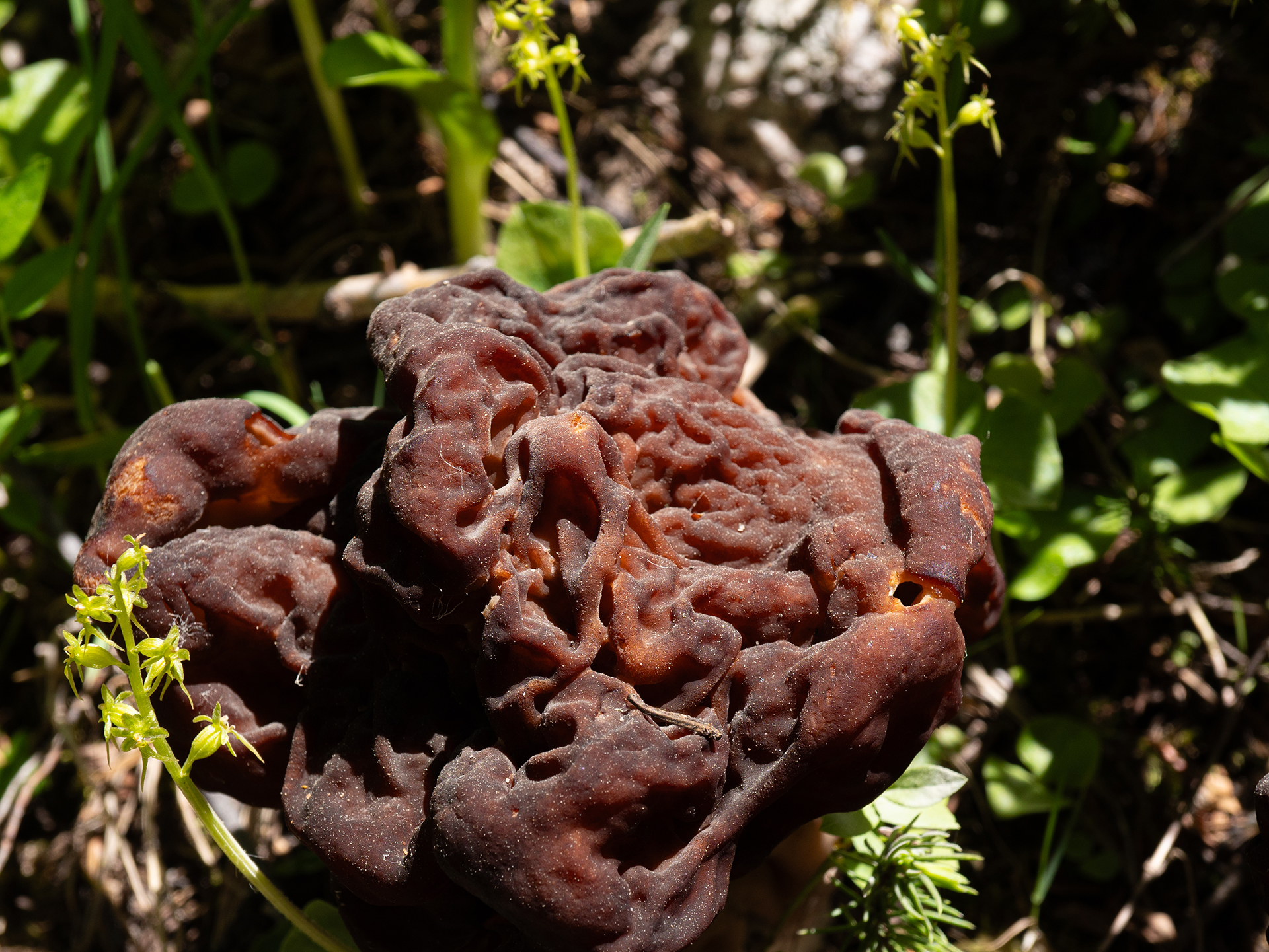
Chanterelles (Cantharellus cibarius)And some nice chanterelles from 2007.Morel. I have found one in 30 years of mushroom hunting (Morchella).MorelVery very rare Rosy Goblet (Microstoma protractum)Rosy gobletClavariadelphus truncatus (club coral) seems to grow in places that also support chanterelles. They have a very unusual sweet taste.Neolentinus ponderosum, late June 2016, coming out of stumps in profusion.Note how the gills are serrated, and also generally alternate in size (see lower right).A shaggy mane, Coprinus Comatus.A shaggy mane, Coprinus Comatus.An oyster mushroom (Pleurotis ostreatus) on left. Not sure what is on right.In the early summer of 2011 I found a group of Gyromitra esculenta (below, near intersection of Gore Range trail and Willow Lakes trail), which were new to me. They can be quite poisonous, so I was not tempted. But they look intriguing. In 2012 and 2013 I saw a few on a trail very near our house.The gyromitra are also known as false morels.Hawk’s wing, or Hydnum imbricatum, also known as Sarcodyum imbricatus. Edible, but I have not found them very good.Hawk’s wingSome young leccinum, often mistaken for porcini, from the end of my driveway. The cap underlaps the sponge, they shake when touched, and the base is not bulbous and stains dark on being scratched.Note the underlap of the brown cap. That does not happen on porcini.Pholiota squarrosaHere’s a nice puffball. These are edible, but the flavor is minimal so I don’t pick them. Calvatia booniana I think.Puffballs. I have seen them near 14000 feet.Pholiota squarrosa: These are very pretty (but inedible) and can be seen, rarely, under aspen trees.Pholiota squarrosaA nice young pair of Russula emetica.Hygrophorus subalpinus (or Supalpine waxy caps), found June 13, 2017, not far from the Ryan Gulch Trailhead at 10000 feet. These look a little like Agaricus Campestris, but are much more substantial and have totally different gill color. They also look like some Tricholomas, but again, the lack of an odor means they are not. They emerge near snowbanks, and there was indeed some snow remnants nearby.Hygrophorus subalpinusHygrophorus subalpinusHygrophorus subalpinusArmillaria ostoyae, the honey mushroom, was out in great quantity in late August, 2013. Note how the white spores from the upper ones land on the lower ones.Honey mushroomsHeartleave twayblade (an orchid) and a very large gyromtira, largest I have ever seen.Agaricus campestris. These have pink gills when young, turning brown (never white). They are like grocery store mushrooms, but with a much fresher and richer taste.Meadow mushroom (agaricus).The gills turn brown with age.Amanita muscaria (Fly agaric)Amanitas and porcini are often found together.They can be really close!This is not really a mushroom, but is pretty: Leaf lichen, Cladonia chlorophaea: (Aug. 15, 2017, Ruby Gulch, Montezuma, 11400 feet.Same group as preceding (photo by Dan Schwalbe).