
2000, June: Mt. Logan, Yukon, Canada

We were fortunate (thanks to Susie’s initiative and enthusiasm) to win the Moonstone People’s Epic Contest for 2000, which yielded us a nice sponsorship package (cash and gear) from Moonstone Mountain Equipment. And we were fortunate to have good weather at Camp 4, 17000′. Note the Nepalese prayer flags. Rear: Susie Sutphin, Katie Larson. Front: Leslie Ross, Stan Wagon.
Personnel, Background, and Training
Stan Wagon, 48, professor of mathematics, Macalester College, St. Paul. Minn, and resident of Silverthorne, Colo. (9500′) [anagram = WANT A SONG?]
Katie Larson, 35, Montezuma, Colorado (11100′) [SOLAR INTAKE]
Leslie Ross, 31, Breckenridge, Colorado (10000′) [I SELL ROSES]
Susie Sutphin, 30, Truckee, California (7000′) [HUTS? I USE PINS]
Two years ago I was on Mt Logan with guide Ruedi Beglinger, but I had a sore back going in and had to leave after four days at base camp. On that trip Ruedi and his group attained the West Summit (19440′, 100′ lower and 1.5 miles distant from the main summit). But I got a small look at the route and the organization required, and so was inspired to organize my own attempt on Logan. Katie had climbed Denali that season, organizing all the food, and so she was a natural choice. Her two friends Leslie and Susie are superb and fit skiers (all of us in telemark style), and that made us a nicely compact group of four. Susie wrote a proposal for Moonstone’s People’s Epic Contest, and it won out over 20 such proposals, which earned us $2000 and about $2000 worth of Moonstone gear (which performed very well).
Leslie and I camped out one night and climbed 14430-ft. Mt. Massive in March. Katie and I were on a 9-day desert backpack in Utah with 50-pound packs just prior to Logan. Susie did many tours at high altitude in California. I spent a lot of time dehydrating a huge amount of fruits, veggies, and rice. Katie planned the meals, Susie organized a first-aid kit, and Leslie gathered the materials for a repair kit. We gathered a few times to practice prusiking and crevasse rescue. One winter camp from two years ago is worth mentioning: I joined Katie and her Denali gang for a night on the St. Mary’s Glacier around Christmas, 1997. It was a terrible night with snow and very high winds. We had nothing approaching that on the Logan trip in 2000.
The Mountain: Largest in the World
Logan is the largest mountain in the world. Its total volume is greater than that of any other mountain. It has more terrain above 17,000 feet than any other mountain (about 40 sq km, or 15.5 square miles). It is the highest peak in Canada and the second-highest in North America. It is in the center of the largest glaciated area in the world outside of the polar regions. The first ascent of Logan in 1925 was an amazing achievement that involved the hauling of 10,000 pounds of food and gear over several months. In short, this mountain is BIG. The altitude of 19540 ft (5956 m) is slightly less than that of Denali. Remember that the natural bulge of our rotating planet means that an altitude of 19000′ at this latitude (60 degrees) yields an air pressure equivalent to about 21000 feet at the equator (or 20000 feet in Colorado).
The Days Before the Trip
May 11, 2000: On the airplane out of Denver. I am cursing myself for telling Katie that they match people and luggage and so the plane would not leave without her. Twenty minutes before scheduled departure she visited a shop. She was not at the gate one minute before scheduled departure, so I boarded, fuming, and her seat was given to someone else. That fellow was certainly very grateful to his unknown benefactor. With luck she will get on the next flight to Seattle and still make the Anchorage connection. Otherwise, I am happy that our schedule has two packing days in Anchorage.
Ignominy of ignominies: Katie gets to Seattle ahead of me on a later (faster) flight. I did not think to look for her in the bar in Seattle and so could not find her! Eventually we found each other. Next time I visit an airport with her I will bring walkie-talkies.
Arrive Anchorage 1 a.m. Leslie is waiting for us. Rent large car; drive to the house of Brian Wick and Hilary Davies, who have graciously allowed us to use their place as a staging area.
May 12, 2000, Friday: I lecture at the Univ. of Alaska on snow sculpture while Katie and Leslie buy and pack food. That is a very big job and it is a little intimidating to see it all laid out: ZipLoc bags everywhere. But finally it is all packed away in duffels. 18 days of food, with 7 more days of food for base camp. Susie arrives 4 pm. It is light very late here, until about 11:15 p.m., and K and S have never seen that before and are excited. One discussion we have is whether to move immediately from base camp and camp higher on the first night (Katie’s plan), or to spend a day acclimating (Susie is concerned, and has been altitude sick in Nepal (Ama Dablam base camp; going from 9000 to 15000 too quickly)). Probably it is sound to set up a base camp.
Brian showed us an interesting bike puzzle: Take a bicycle and have a friend balance it with one hand pressing down lightly on the frame or handlebars. Place the pedals so that one is at the top of its circle and the other at the bottom. Then push the lower pedal toward the back of the bike. Will this cause the bike to move forward or backward? Try it!
May 13, 2000, Saturday: Pack till you’re tired and shop a little. Went for a walk and saw three whales, two eagles, and a moose. We are still not certain about the pickup time tomorrow; maybe 7 am.

First Five Days: To Camp Two
May 14: An amazing day. We were picked up by Ultima Thule Lodge’s van at 7:45 a.m. Drive to Chitina arriving near 1 pm. Pilot Paul Claus immediately snags the three ladies for his plane, leaving me to fly with his father, John. John landed a bit hard, having landed in the wrong direction in light winds: “We went in like a hot bullet.” Paul landed in the opposite direction. Upon arrival at the lodge Paul said the weather looked good for flying right to base camp, so we should just organize quickly. Uh-oh. This was not part of the plan and haste makes errors. But the chance of getting in a day early was too good to pass up. So after a quick lunch we stuffed a bag to stay at the lodge and piled into the 40-year-old Beaver for the spectacular 50-minute flight to base camp at 8900 feet. No last-minute showers for us. As we approached base camp Paul observed that it was clouding up and perhaps he would have to drop us off short of base camp, coming back for us the next day. That did not sound like a good plan. But it cleared up and he dropped us right into the 9000-foot level on the huge Quintino Sella Glacier. No one else was there and there were only two camps set up (fewer than two years ago). Paul said we should just use the existing walls. He suggested we take 21 days of food up rather than 18, since he never takes more than 4 days to get someone out of base camp. At our cache we left tequila and margarita mix and our avalanche beacons, and misc. other things, burying it all and marking it with two wands attached by duct tape. The weather was somewhat unsettled, temps being about 10 degrees. For the next week or so the temp. inside our tent at 6 a.m. would vary from 29˚ (F) down to 17˚ or so. But at the very high camps this changed—downward—a lot.

So we settled into our tents, sorted gear, and prepared for the hard carries ahead.
May 15 (Day 1): Katie said single carries were possible on this flattish terrain, so we packed our packs heavy and pulled the sleds. Of course, the terrain for the first mile only was familiar to me from my trip here with Ruedi Beglinger two years ago. I had to pull out of that one after a few hours becase of a bad back. We roped up for this, as we did for all terrain that was new for us. I led through the small icefall; a few small crevasses had to be crossed. Then we were above it and on easier terrain, but we tired quickly and ended up setting up camp at a small snow shelter a little more than halfway to Camp 1. Call this Camp 0.5 (10250 feet). Leslie had mild indigestion this day, and I think the magnitude of the effort involved sunk in. By 9 pm all are enthusiastic again. We covered 2.5 miles and 1350 feet of climb in the 5 hours from 11:30 to 4:30.
May 16, Day 2: Again a single carry to the proper position of Camp 1 at 10800 feet. A short day. So perhaps the single carries were efficient in that two days spent getting to Camp 1 involved fewer traveling hours than double carries and returns. On the other hand, the returns can provide excellent skiing. In any case, since the terrain now steepened, we would have to switch to double carries. This camp is in the heart of the King Trench and it is spectacular. Weather is warm and serac avalanches come off the side of the ridge of King Peak. Camp seems very safe. Katie helped me adjust my sled-hauling method. Robin Shaw, from two years ago, wrote a detailed diary, which we have with us. I recall his quote that it is better to do a trip like this with a group of friends than with people thrown together by a guide. Indeed.
Ouch!!! In the early evening, as we were all lounging around, I heard a very loud “[expletive deleted]!” from the small tent. It did not sound good. Then, a few seconds later, from Susie: “I cut myself real bad!”. Susie had her Swiss army knife hanging around her neck with the blade open. She reached down to grab the knife and grabbed the blade, which was sharp enough to cut two fingers. These cuts were of the sort that I have occasionally done to myself in a kitchen: small slices through the end of the finger (and, indeed, several days later I cut myself mildly when slicing bagels). So there was lots of blood on the snow and Susie was in a slight state of shock. But the medical kit, prepared by Susie, had the proper gauze and bandages and we soon had her two fingers properly bound and gauzed. Naturally there was concern that these fingers would not heal properly and might be more prone to frostbite. But in fact they healed well and caused no problems later in the trip. Susie also noted quite a swelling on the back of her hand (her other hand). We thought it might be a small injury caused by pole straps, but there was no bruising, just a swelling that got worse the higher we went. I imagine this is a natural phenomenon associated with altitude. It gave her some pain, but eased at the end of the trip.
May 17, Day 3: Clear blue-sky morning. 19˚ in tent. A big carry to Camp 2 at King Col (13500 feet). This involved 4 miles and 2825 feet of climb and was quite tough because we had loaded the packs heavy. I am certain that the packs were over 60 pounds. This was hardest on Leslie, who weighs 115 pounds. We decided to leave our sleds at Camp 1, both because we felt that packs were better for ascending, and also because we had Robin Shaw’s diary with us, and he reported that some of the slopes to Camp 2 were too steep for sledding, and they carried sleds. This decision of ours would haunt us 12 days later.
The terrain was beautiful with giant seracs on the left and the rocky, icy slopes of King Peak on the right. The camp was hidden until the last minute, and I had thought (because of an error in locating the altitude of Camp 1) that we had only 2500 feet to do. Thus the crew was quite exhausted when we reached camp at 5:40, 6.6 hours after starting. There were lots of walls there and two people: Jennifer Olson from the 3-person glaciology team and Karsten Heuer from the 6-person team leading blind Ross Watson. We cached our gear in an igloo they had built and headed down quickly. The girls are all expert telemark skiers so the trip down (unroped) was most enjoyable: 30 minutes. This day afforded us our first view of The Icefall, which is the steep terrain above King Col. This is generally the route-finding crux of the route, with huge seracs that must be negotiated. Indeed, the seracs of this section are by far the largest I have ever seen. But there are tracks (boots) up a steep slope and looking at the angle we are confident we can ski up the near 45˚ slope.
The ski down was in excellent powder, and the girls, as always, looked very good on descent. They are among the best telemarkers in the country. My quads burned, but I had fun. Katie has instep blisters because of her new liner situation (special high-insulation material), but some Compeed will help them, and she will take out the foot beds entirely. Susie’s fingers seem OK.
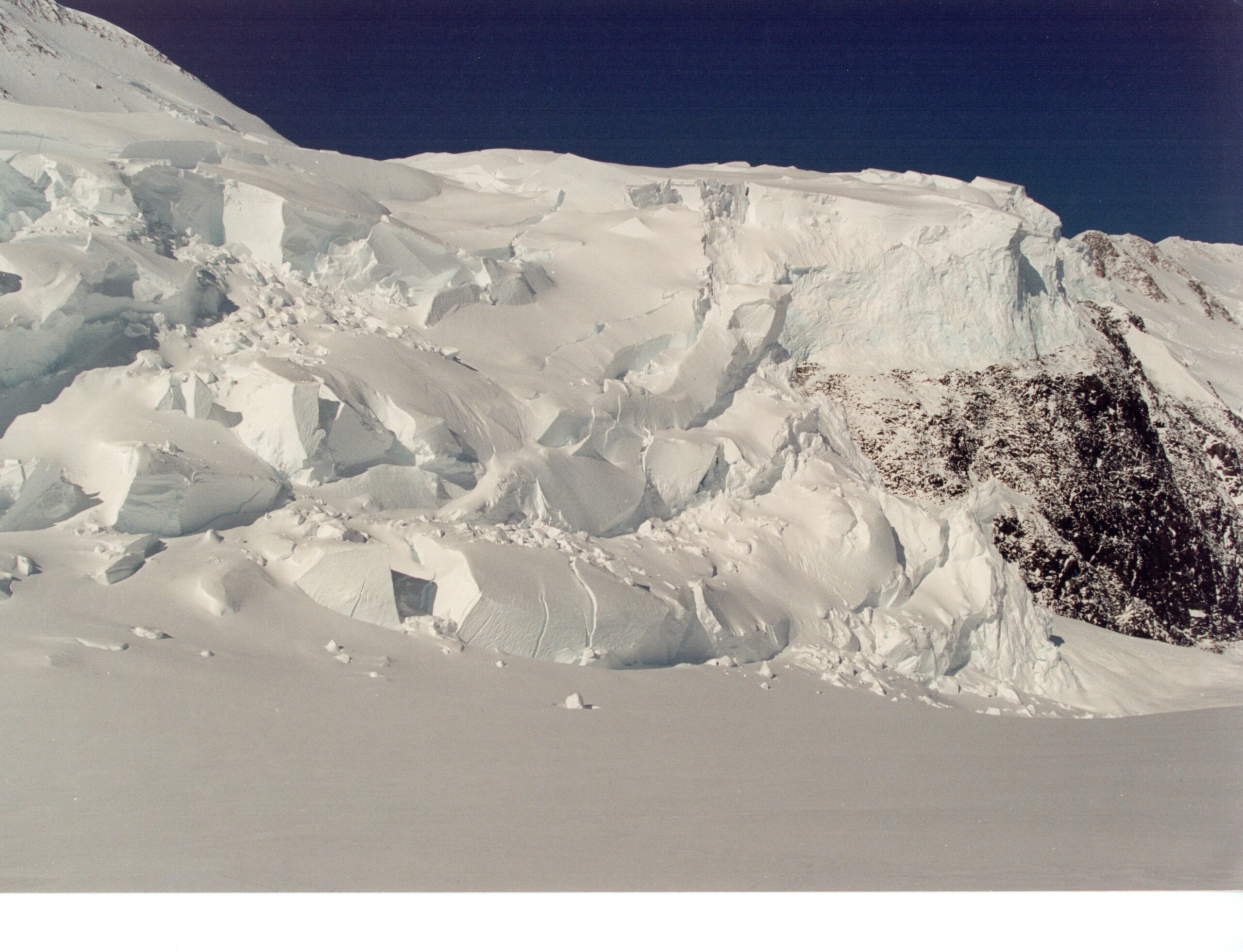
May 18, Day 4: Dawn is cheerful. Susie and Leslie are both drinking a lot to help with altitude issues, and S proudly presents almost a full liter of urine in the morning. Urination into bottles within one’s sleeping bags was a main topic of conversation (though irrelevant to me, as I urinate before going to bed and after waking up, and not in between). Weather is okay. This time we take less than 5 hours to gain King Col with the second part of our load. But we really don’t eat or drink enough en route (eating heavily at dinner) and this causes Katie, despite her strength with heavy packs, to end each day feeling chilled. Susie and Leslie have CamelBaks, which give them easy access to water, at the expense of some weight and complexity. Our loads today are about 40 pounds. Camp 2 is now deserted. We should have balanced the two loads better. That evening we decided to take a rest day on the following day. But our luck with the weather continued in the sense that the weather was BAD the next day, so we would have had to rest anyway. This night spent at 13500 feet is the highest night ever for Leslie and me. The sea level equivalent barometer is 29.44, very low and, I think, indicative of the lower pressure at 60˚ latitude.


FOOD ISSUES: Of course, everything quickly freezes here. So if we want, say, bagels for breakfast or oysters for dinner, we must thaw them out in our armpits or stomach pockets. But in fact it all works quite well, though it does take a lot of time to melt snow for drinking and cooking water. Dinners (thoroughly vegetarian) are either Mexican burritos, Nature burgers, pasta, or, high up, freeze-dried from Backpackers Pantry. Tortillas and bagels keep very well in these conditions.
THE RUDI SUDRICH STORY: At 8 p.m. I was outside urinating when I saw a fellow coming uphill to the camp with no pack, no sled, and no skis. Bizarre. Well, he had just skied down from the summit and was a little lower than our camp, so he walked up to collect some stuff from his cache. He had been here with Judy Hartling, but she got a urinary tract infection and had to go back to base camp with Rudy to fly out. Rudy suggested she had not eaten nor drunk enough. Then he came up quickly from base camp to the summit. They were the first to find a route through the seracs above King Col, a job that took them two days. He is a former coach of the Canadian nordic ski team, and coached them at the Lilliehammer Olympics. He is Czech, but has lived in Whitehorse for 20 or more years. He also said that the other side of Prospector Col was too icy to ski and he had to use crampons. Yet it was possible to ski to the summit. This was very surprising news.
But….we learned later that most of this information was inaccurate. Another team told us that what he told them was: “I skied to the base of the main summit, found it too icy, and then turned around and skied easily to the top of the West Summit.” Well, that made sense, but I now feel that this too is inaccurate. First, our team had no trouble skiing down, and later back up, the other side of Prospector Col. Second, the West Summit is very icy near its top, much more so than Prospector Col. Third, the main summit is sufficiently far from Prospector Col that his schedule (given the 10 a.m. start he reported), seems unlikely. It seems most likely to us that he took the West Summit to be the main summit, turned back, and skied over the peak behind, which is Houston’s Peak. Nevertheless, the fact that he did all this solo, and fast, is noteworthy.

May 19, Day 5: A full rest day. And we learned why the barometer was low in last night’s clear skies: it was a bad-weather day at King Col.
More details of life in these camps: K and I share the large North Face VE-25 tent, while S. & L. have a smaller tent. The sun rises about 4 a.m., and that usually wakes us for a weather check. Then we go back to sleep, rising again at about 7 to clean the rime ice from the tent interior and start the stove. We start by melting snow for water, then heating it for tea and breakfast. This takes a long time, so we are not ready to travel until 11 a.m. or later.

Next Five Days: To Camp Five
May 20, Day 6: 17˚ in the tent at dawn. A clear blue day, even though pressure continues low. I have a 29.42 inches of mercury for sea level equivalent. We carried to Camp 3 at 15500 feet, just below the more normal 16100 flat area of the Football Field. This was perhaps the best day of ski mountaineering I have ever had. The weather was perfect, we had to go through a complex icefall with interesting but unsurmountable route-finding problems. There was one belay at a tricky crevasse crossing. K., while leading and on belay, broke through a little here, but then we found the right way across. Naturally we wondered if this crossing would get worse in a week or two, but in fact the cold weather and snow made it much easier later.
15500 is a new elevation record for me (though not the others). Two members of the Quebec party are there. And from here, looking between Mts. Vancouver and St. Elias, I saw the ocean. And Karsten was there too. He told us that Rudi Sudrich’s claim was only the W summit.
The descent involved some synchronized telemarking while roped. Susie suggested that positions 1 and 3 turn one way while 2 and 4 turn the other. That worked well when we managed it. All of us have slight headaches.
The descent down the steep part was great, both for the amazing seracs on either side of our route, and the great snow we got to ski down in. The slope above Camp 2 is about 43 degrees, perfect for skiing, but also a slope that allowed us to skin up fairly easily in the morning.
In the evening Katie and I walked to the edge of the flat terrain south of King Col. This offered stupendous views including a look at the Logan summit, Mts. St. Elias and Vancouver, and the huge icefields below. And, most impressive, this vantage point gave a good view of a large part of the south face of Logan, including parts of the Hummingbird Ridge. A beautiful end to a great day…and the weather looked good (despite the low barometer that continued).
Stats: 2100 feet climb in 5 hours. 1 hour down.


May 21, Day 7: Final carry to Camp 3. The barometer is taking a nose dive and there is no visibility, but we are familiar with the route and there is no wind, so we decide to carry up. Now we are leaving trash and other small bits of stuff in a cache at each camp. I volunteer to lead, but that doesn’t last long. I had placed my skins on my skis the previous night, and now they are not sticking at all. A third of the way up the steep slope out of camp one of the skins comes off. So I must boot it up, carrying my skis. Leslie says she has a spare pair of half-skins I can use, but when we get to a flat spot for a rest, they turn out to not be in her pack. Thus I must resort to the tried-and-true duct tape method, which I know will last for several hours.
Now Katie is leading and the white out is pretty total. There are occasional wands, but mostly we are relying on our memory from the ski down yesterday. At one point Katie punched through badly into a giant crevasse and my rope discipline in position two was not as taut as it should have been. The bridge broke away, with a loud noise, in front of the binding of her ski so she did not fall. She just backed away very slowly and we found the right way across. She was quite terrified by this, but showed good leadership in not showing it.
We continued up in these difficult conditions and finally spotted the welcome sight of some tents at Camp 3. This all took 6 hours. We were somewhat cold, but some snuggling and resting of feet against stomachs got us back to good spirits. Katie and I assured Susie and Leslie that we would not again travel in total whiteout conditions like that.
ASIDE ON GENDER: The fact that our group consisted of three beautiful young ladies and one short, balding, older guy certainly elicited comments from people. I am reminded of the scene at the end of Annie Hall in which the Diane Keaton character leaves Woody Allen for the short, balding Wallace Shawn fellow. At base camp at the end of the trip I noticed a couple of guys looking at the girls, looking at me, and smirking in wonderment. Well, the girls were strong and enthusiastic and a pleasure to be around. Perhaps females perspire less than males…in any case our camp and team were clean, clean-smelling, and (almost) always in good spirits.
At this point I wrote in my journal that things have gone very well, the team is pulling together, and I estimate a 70% chance of reaching the summit. I also wrote that even if we don’t summit, the trip so far has proved worthwhile, mostly because of the superb icefall views between Camp 1 and Camp 3.
Our resting pulses are all about 72–80 bpm. My respiration rate was 13, with the others a little higher.
May 22, Day 8: Tough morning. The weather looked ok at 8 am, after a very cold night. We decide to try a carry to Camp 4, although Susie is not feeling well. At 10 a.m. I heard a funny sound from the stove. We race to look at it and see flames leaping up. There was a leak at the O-ring, probably caused by frost when we changed bottles. No harm done. We finally start up at noon, but now there is no visibility and wind and snow. After a short climb we decide to turn back to camp and take a rest day. Katie also has a headache, so resting seems fine, especially considering the hard work of the previous day. Leslie accidentally poked her ax through the bottom of our tent, but it was easy to repair the small hole.
May 23, Day 9: The weather seems only slightly better, but it looks okay to travel. We had a fine carry to Camp 4 in steadily improving weather. This was only 1600 feet of climb to 17000 feet. The camp is crowded, so we will have to build some walls. But we would also like to carry some of the stuff farther, up to Prospector Col at 18400 feet. We see teams heading up there and it looks easy. So Katie and Leslie volunteer to do that while Susie and I build walls and a latrine for tomorrow. Katie decides to forego the switchback that is set, and heads straight up. Susie and I work hard on the walls with a borrowed saw. At one point I wondered if the col everyone was going to was really Prospector Col. I took an inconclusive compass reading. But I was too hasty: of course, it was correct, and I was fooled by its being around a corner.
The other teams: The CNIB team with Ross, who is blind, led by Jay and two others. Karsten and Alex are the photographers of that group, but Alex is not feeling well, so they will not go over the col. Incidentally, on day 8, our hard day in whiteout conditions, Karsten and Alex traveled from 3 to 4 but did not make it and set up camp a few hundred feet below camp 4. Ross had summitted Denali several years ago. Incidentally, there seems no question that summitting the true Logan summit is more difficult than summitting Denali.
The Montreal, Quebec, team: 6, from a shop called YETI.
The weather station team: Jennifer Olson, Larry Dolecki, and Mike.
Susie and I return to Camp 3 in 23 minutes, and start melting and boiling water. Leslie and Katie return at 7 pm in full parka gear, reporting very cold weather at the col. Our cooking mission is not going well. Indeed, several hours later we have hardly made any progress. We finally decide that the stove is clogged and eat a lukewarm dinner. The next morning we switch stoves and that makes a big difference.
We learned from the Quebecers that temps at Camp 3 were at least -31˚ F. This blew me away: I had no idea things were that cold. We will later learn that temps at the highest camp, at the other side of Prospector Col, got down to –40˚.
I recall Chic Scott saying that one could perhaps move from Camp 3 all the way over P. Col in one day, bypassing Camp 4. It is true that the distance is not great. But loads and strength vary from party to party. Only a strong party traveling light and starting early could do that.
May 24, Day 10: Clearest dawn so far and breathtaking views from Camp 3 to King Peak and Mt. St. Elias. We have an easy carry—3.5 hours—to Camp 4. At one point we were buzzed by a white bird (seagull?). Alex helped take a picture of our group with the Moonstone banner. My feet get cold on these days, but they warm up a bit when we rest. I wonder if the pressure of the heavy pack can have an impact on this issue. Yes, I just heard confirmation from a veteran (Gerry Roach) that heavy packs can cause cold feet.
Katie invites the three others at Camp 4 in for dinner (angel hair pasta with a good sauce), but by the time dinner is ready, there is one taker, Karsten. One problem might be that we never changed time zones: we have stuck with Anchorage time, while everyone else is working with the correct Pacific time; the change-line is at the US-Canada border, which we flew over. In any case, 5 in the tent was fine. 7 would not have worked.
At this camp we socialized quite a bit. Alex Taylor, video man for the CNIB group and veteran of a recent Antarctic expedition, introduced me to Ross, whom he was taking on a walk around the compound for exercise. And Alex gave me four of his bamboo tent stakes (which had visited the Antarctic). We had been using the little metal North Face tent stakes, crossing two of them for anchors. This worked, but it was very tedious to install and remove them. A simple thin pole about two feet long is better.
May 25, Day 11: A hard day over Prospector Col. We do have some weather prediction news, and it seems to be that today would be a good summit day, but it might not last. Still, the weather is so good that we have to go up and over. We started at noon (Anchorage time; 1 p.m. local time). The trip up wasn’t too bad and afforded some great photo ops looking back on King Peak and Mt St. Elias. The descent on the other side was on hard windpack that was challenging but skiable. We saw a few wands and then placed our own. We traversed high, seeing the camp of the CNIB team somewhat lower than us and the weather station team higher, at Russell Col. At this point Susie’s toes became quite cold and there was a little dissension as we were not yet at the flat area around the next corner where we planned to camp. But we had to stop, and so we camped below Russell Col at 17500′. This day was the summit day for Ross’s group, and they made it to within 70 feet of the top of the W Summit. That is quite a reasonable achievement on a very cold day, and, of course, with no vision for one member. Ross lost the sight of one eye a long time ago, and apparently the other one went in some sort of sympathetic response. This must be somewhat unusual because, after all, there are plenty of one-eyed people around. Indeed, one of Katie’s partners on Denali had one eye.
The French team had left their skis at P. Col, and were using only crampons at this point. They were camped around the corner where we had wanted to be.
Weather at night was very cold and windy; not high winds, but given that the air temp is 40 below, one really needs no wind to be comfortable.


The Summit Plateau: –40˚
May 26, Day 12: Weather is no better. French come in, tired and cold. Two of them tried for the W Summit, but failed. One of them, Barbara, has moderate frostbite on a finger: a large blister that she showed us at base camp several days later. I am not sure it would turn black. At this camp we are higher than the highest camp on Denali, so we are, for several nights, the highest people in N. America, with the exception of the three who are camped at Russell Col 150′ above us.
May 27, Day 13: Promising start, but we cannot travel as vis. disappears. Visit Larry, Jennifer and Mike. Mike sits in his tent with no shirt on! They are a little down because their project is not going well because of a lack of helicopter support. I enjoy talking to Mike (a guide) about routes in Canada. He has climbed Logan before and he tells us that our plan of traversing around the W peak is a sound way to reach the summit area. Jennifer says she would like to join us tomorrow. She is a certified assistant guide, and we welcome her. We trade a nose guard to Jennifer for some toe warmers. In fact, these work quite well for about 6+ hours and I used them on summit day and on the day following. Katie had overboots in addition to her special liners, while Susie and I just used stock telemark boots and liners and insulated gaiters. We were all cold from time to time, but generally all right. The weather station group has a radio and their forecast is for a reasonably good day tomorrow.
May 28, Day 14: The big day. We try to get off early and are moving by 10, with Jennifer along. Of course, we have spent some time deciding whether our objective should be the main peak or the west peak. While I favored the latter, I also felt that to try and fail on the main peak would be reasonably honorable, so I had no objection to that plan. It was 4 miles away and 2000 feet above us. We started well (except that my skins wouldn’t stay on in the cold snow and I had to resort to duct tape; and I needed another stop to remove my parka; amazingly it was almost warm this day!). As we reached the first slopes of the west peak we started traversing. Pretty soon we needed crampons on the hard and moderately steep windpack. We put them on quickly enough, but soon our team’s inexperience showed as some were concerned about the exposure. We managed to walk through this steep part with no great difficulty (I had to readjust my crampons at one point) despite the moderately heavy packs (skis attached). But then we got our first surprise when Jennifer was no longer with the group. As it turned out, she had a problem with a strap on her instep crampon and had to retreat a bit to adjust it. What to do? I felt we had to return to look for her, and I went back, sans pack, a long way. I saw no sign of her, nor sign of a fall or ascent, and so I concluded she had returned to camp with some difficulty or other. But this cost us a lot of time and energy.
When I caught back up to the group, we sat a bit to figure out where we were. At first I thought we had completed our traverse and were looking at Logan, but K. felt that it was only the W peak we were looking at, and a GPS reading confirmed her view. Then it seemed to me imperative that we leave our skis behind if we were to go forward, as the weight would slow us down and it seemed unlikely that there would be any skiing ahead. But the various issues of the day had sapped our motivation and we decided to go for the W peak only. That seemed fine to me, so we carried up to a high shoulder of the W peak and dumped our packs. The peak looked to be just above us (confirmed by my altimeter) and an easy crampon.
So up we went. I still felt quite good at this 19000+ altitude, though the cramponing on the moderate ground was surprisingly slow. At one point Susie spotted Jennifer coming up in our tracks, which eased our minds. However, for K and me up front, it was one false summit after another. Leslie lost her motivation to continue, and at what we thought would be our high point K and I were discouraged to see a rather sharp-looking bump ahead. At first I thought it was Logan, and the usual “Where the hell are we?” discussion ensued. But Logan was two miles away, and this bump — the summit cone — was a short distance away. It was indeed the  , but it looked very steep and intimidating to us, as if it would surely require a rope for our team (which, of course, was left in our packs behind us). As we later learned, it would have been fairly simple to walk over there and crampon up. But I guess we have good eyes for ski routes, and not for climbing routes.
Ross’s team had indeed climbed this to within 70 feet of the top, and Ruedi Beglinger, two years ago, did indeed snowboard off very near the top of this bump. In short, we were intimidated by it and decided to return.
So that’s it: The great summit day in good weather, and we come away with only a day of strolling up to 19300 feet. A lesson learned.
PRESSURE: A chart in Ward’s “Mountain Medicine” shows that the barometric pressure we were seeing (lowest was 29.44 sea level equivalent)—which translates directly into partial pressure of oxygen—at 20000 feet is 46% of that at sea level.
Probably the biggest reason for our summit failure was our belief (also confirmed by the view of the west and main summits from King Col) that the west summit was a fairly gentle slope that we could easily walk up.
Another interesting contributing factor is the use of the word “plateau” to describe this whole area. “Plateau”, as in plate or flat. Well, it is not flat. There are crevasses and exposure in this area, and one needs a very exact plan in order to get the main summit. One can do as the first ascenders did and go over the top of the west summit, but that would add 1600 feet of climb to the day, which, for us, would have been too much. One could also go very low and take a direct route — that might have worked. The traverse we tried still seems like the best route, but one needs very good information as to where one should traverse. As Ruedi Beglinger later told me: “For this choice, if you are a little too low or too high, you are in trouble.” Our feeling now is that we should have ascended the slope to the west peak on skis (as opposed to the roundabout cramponing route we took—we were too low), and then traversed on the shoulder quite close to the W Summit.
So we turned around, skied down the incredibly difficult windpack back to our wands, and cruised around (well, in fact it was quite flat and slow) back to camp at 6 pm. When we switched back from crampons to skis I had a little pain incident, as my hands had gotten too cold in my time spent with the maps and GPS. I guess they slightly froze and thawed quickly, but that causes a lot of pain, and there is not enough oxygen to scream properly!
While it was a little sad that our expedition was denied any moment of self-congratulatory hugs and photos at a summit of any sort, we had given the peaks our best effort. We had gotten this far on our own (admittedly, following the tracks and wands of others), and it did give us an appreciation for what the first ascenders did: they climbed the west summit, only to get a glimpse of the main summit almost two miles away. They did that of course, and then spent two nights in open bivouacs before returning to their last camp. We managed to come this far and never even see the main summit (except from King Col).
Jon Waterman, in a TV program, called that pioneering first ascent one of the greatest tour-de-forces of mountaineering history. They really suffered on that trip: his video has interesting footage from the event.
And now I would have to tell the editor of a math journal to change the bio. for me that he had composed. Instead of “he skied to the summit of Mt Logan”, he will have to say “he skied to near the summit of Mt. Logan.” And of course, everyone will ask why we didn’t make it (answers above), was it too hard for us (probably yes), and so on. But these questions completely dodge the central questions: Did we have fun? Absolutely. Did our equipment work? Yes. Was the team a good one? Yes. Did you see anything interesting? Oh, yes. Any regrets? Really, none. And, of course, the biggest thrill for me was that we got as far as we did entirely on our own. All the food and planning and research we carried out on our own, with the risk that that entails. And, indeed, I must take the blame here for not doing more thorough research on the route for the final day. However, I now feel that even if the route had been wanded right to the summit, we might not have had the strength or desire to follow it. And another point of satisfaction for us was our speed. Although it seemed like we were moving slowly, the other teams commented on how fast we were. Indeed, our time to the plateau, 11 travel days, was quite good.
SOUND NOTE: As we cramponed over that first section of the day, there was a taste treat for our ears. Each step would reverberate through the snow in a way I had never heard before. And little snowballs falling down the hill would also cause surprisingly loud noises, as if someone were talking into a radio. Unusual.

Marathon Descent
May 29, Day 15: Late start (noon). Most of the team is keen to get all the way to base camp; this seemed like it would be very difficult, but I was willing to try. Katie went up to visit Larry et al while we finished packing. We then met up and followed our wands (retrieving them) to Prospector Col. This section was very difficult because of the hard windpack. We did manage to ski up the whole way, but were exhausted at the top (2.5 hours for about 800 feet). Our wands were a great help as it was a bad weather day. But this is it: off with the skins and prepare for a descent of about 9000 feet. And the recent snows had built up a little, giving us a great powder descent back to camp 4. And, of course, we were now on the south-facing side of the mountain, which is warmer. We need no longer fear for our noses, fingers, and toes.
At camp 4 there was only a new party of two, and of course we chatted with them. Jennifer, Larry, and Mike were behind us and they lent us a sled that they did not need. This was much appreciated. The party of two said it was all right to leave a gallon of fuel there, as other parties coming up would use it. With that, we were able to fit everything into our packs and one sled (roping up so that a tail skier could slow the sled down) and make it down quickly to camp 3.
There we found the group of Canadian wardens who were ascending. The interesting story there was that only some of them flew in with Andy Williams from Kluane Lake. The weather was poor and some of them got tired of waiting, so they drove all the way around to Chitina, Alaska, to try flying in with Paul Claus. Paul got them in promptly. That is certainly the best vote for the efficacy of using the western approach to this western route up the mountain.
The descent to King Col was along a wanded route that differed a little from our ascent route. Susie and Leslie did a good job in the rear of holding back the sled that was attached to the rope behind me, in position number two. This was exhausting and slow work for all, but soon we are past the final hard crevasse crossing (an easy ski now, with all the new snow), and unroping for the final steep descent to King Col. Katie went down first, leaving Susie and Leslie to help me with the sled. For the first part of the descent I could manage to scrape down in control. But at the second, steeper part control was impossible, and some gear fell out of the sled. No great problem, but it was discouraging to see two bags spread out over the mountain.
I got down okay and there were no great problems, but now our team was spread out and it was not clear if we should camp here or continue on down to Camp 1 and perhaps base camp. We did eventually decide to push on — hey, it’s all downhill and it never gets dark. But one problem facing us was how to carry our gear. We had to leave Jennifer’s sled at Camp 2, leaving us with two heavy duffels to maneuver down. It was not at all clear that we could drag them behind us in the new snow. S and L retrieved the gear from the Camp 2 cache and we loaded up. Susie and Katie decided to try to carry the duffels in front of them and, indeed, that seemed to work, though it was exhausting. As we descended, conditions deteriorated to white-out and, with the sun descending (at its usual snail’s pace) the wands becames harder to see. By the time we were down the steep slope a mile from Camp 1, visibility was zero. Well, I guess this is the time for the GPS. I warmed it up a bit and took a reading, which told us that Camp 1 was a mile away at 300 degrees. So I tried to maintain that bearing. Incidentally, a few days before we began this trip, the U.S. govt. stopped degrading the GPS satellite data, so accuracy is much improved now.
Maintaining such a bearing for a mile is difficult, and in fact I was veering a little to the right. Nevertheless, the GPS does get credit for getting us away from our zero-vis position. Despite slightly improving vis., we still saw nothing except the camp of Reudi Beglinger — the circus tent familiar to me from 1998 — off to the left. That is surely left of our camp and cache, so we were unsure what to do. I took another GPS reading, but this time I got a very strange result, saying that Camp 1 was way behind us — totally wrong.
Leslie and I decided to go over to Ruedi’s tent to see if he had spotted our camp. In the way there we could see a rise in the snow in the distance that looked like the wall and half-igloo of our camp. That was a nice feeling — given the flat terrain, this must be what a lookout in a ship’s crow’s nest feels like when he spies land in the distance. Still, we continued to Ruedi’s to say hello. Of course, he was surprised to see me, since he did not know I was on the mountain. We chatted a bit about the route, etc., and one member of his party was from Vail (Deb DeCrausaz) and knew Leslie. Ruedi said he would call the park wardens and tell them we were at base camp. So we had to continue all the way now.
Then on to our camp and the long anticipated sleds. Leslie and I went first and then I grabbed some sleds to bring to the stolid duffel carriers behind us. Katie was almost at camp at this point, so I went farther back to Susie. As I stepped out of the trail to place her duffel on the sled I was very surprised to find myself breaking through a snow bridge into a moderately sized crevasse, this on a totally flat and white section. The skis, as usual, kept me up, and I gingerly stepped across. Bit of a surprise.
Actually, Susie and Katie, carrying the duffels, chose two different routes for the last half-mile, having a race of sorts. In fact, this is very bad practice: when traveling unroped on a glacier, parties should follow the same route, for the usual reasons of minimizing exposure to crevasses and having help handy if required. Susie was in terrain that we had safely skied over two weeks earlier, but the surprise crevasse shows that vigilance is necessary.
At Camp 1 we repacked as the hour approached 10:30 pm and sunset. But visibility was increasing: indeed, the late light was spectacular on the walls of the King Trench. The only problem was that there was no track set to base camp and we had a serious trail-breaking job ahead of us. But we managed and crawled into base camp at around 1 a.m.
A big surprise here was that the wand marking our cache was nowhere to be found. It clearly could not have been buried. Curious. But we needed sleep so just set up our tents and crawled in. Katie rose at 6 to search some more and found our cache where we had placed it, but marked by a different wand. No explanation suggests itself except that, perhaps, our wand broke and someone replaced it for us. The cache, of course, was of critical importance as it contained our tequila and margarita mix, as well as avalanche transceivers and other material.
This day was one of the most remarkable of the trip. We saw a lot of terrain in a wide variety of conditions, the day was physically demanding, and the finish was a classic trudge in Arctic conditions: flat terrain in the beautiful dusk light of the angling sun. This is the sort of day that our team, with its strength and skiing ability, was made for.
May 30, Day 16: A very restful morning of socializing, drinking, and a great potato and egg breakfast. Jennifer, Mike, and Larry came down later and shared some tinned fruit and potato chips with us. The Quebec team were around, having been there for a couple of days, and the weather was clear so that Andy Williams could fly in. The first thing we heard that morning was a helicopter, however; it had finally come in to raise the weather station gear up the mountain. But the crew of 3 were not keen to return to 17000 feet, so the installation job was put off until August.
We did hear from the helicopter pilot that Ruedi’s message had gone through, so we had confidence that Paul would get us. I had made a couple of other calls on other people’s satellite phones, so it was pretty certain that Paul had heard about our somewhat early return (we had told him to think about us on June 4).
Around 3 o’clock, we hear a plane, but it is only Andy Williams making his fourth run of the day. But Susie believes she sees Paul in the distance too. And she is right. What is about to happen is a very special moment in the history of Mt Logan flying. First Andy lands. Then Paul lands and, as I predicted, he taxis right over to our campsite. Paul, always interested in the welfare of our group, runs over to say hello to us. But then he and Andy recognize each other’s existence and walk over to each other to say hello. What is amazing about this is that, despite Paul’s 20 years of flying to this spot and Andy’s 35 or so years of the same, the two famed pilots had never before met in person!
We quickly dismantle camp and carry it to the plane and load. Katie gets the co-pilot’s seat to scan the terrain for future skiing options, and we all settle in to enjoy the fabulous ride down. We arrive at Ultima Thule to a lodge devoid of other climbers. The sauna is a first priority, followed by dinner. What luxuries.
Wind Down: The Jim Carrey Story
THE JIM CARREY STORY: We had heard that Jim Carrey, a comedian, was coming to Ultima Thule Lodge in the days after our visit there two weeks ago. But we had not heard the conditions. Ruedi Beglinger says his group was delayed a day at the cabin in Chitina (an unpleasant way to spend a night: no running water) because of this. What happened was that Carrey (along with his producer and psychiatrist) wanted the entire lodge to himself, and paid handsomely for it. So it seems as if the prior reservation of Beglinger was voided. The folks at the Lodge seemed to enjoy Carrey’s company (he went hiking, camped on a glacier, accompanied Paul on a fuel-delivery run, etc: “Hi, I’m Jim Carrey. Here’s your fuel.”). He had come in by private jet to Valdez. Ruedi’s group was, in part, taken directly from Chitina to base camp, though there were weather issues and the second half of the group did not arrive until 7 or 8 hours after the first half.
The evening was a fine one at the lodge. We are introduced to Elly Claus’s (14 years old) 28 sled dogs: She was 8th in the Junior Iditarod and trains with famed sledder Martin Buser. Clearly she can hardly wait until she is old enough (18) for the real Iditarod. She has already snowmobiled the entire 1000-mile course.
May 31: Katie, Leslie, and I, after a breakfast of eggs and caribou meat (the hunting guests over the summer care only for the heads of their quarry; the meat stays at the lodge), hiked to the waterfall. The trail was tough and we felt like we were passing a “stupid tourists’ test”, since we were given minimal directions. But we managed the roundtrip in 2.5 hours. Paul was busy with his FAA pilot’s exam (he passed), and other Lodge personnel were busy with some natural resource folks who were advising them on issues relating the the fact that the eroding banks of the river were getting close to the lodge and runway. It seems clear that the Lodge will have to be moved uphill. The new, higher, runway is already built.
The flight to Chitina and drive (via cashless Doris: we had to buy gas) to Anchorage was uneventful and we stopped at Brian’s and then went to the Holiday Inn downtown. Amusing restaurant story: we were told that the best pizza place was the Olympia, but it was too far to walk. Katie called them and sweet-talked them into picking us up at the hotel, and delivering us back after dinner. In fact, we had a great dinner at this lovely family-owned Greek restaurant.
My phone call to Joan yields two nice bits of personal news: Long-time Mathematica course competitor John Miller has quit, and sent his people to us. So registrations for my July course are now up to a respectable 28, from the anemic 15 at Logan trip’s start.
And the US national snow sculpture federation wants to (1) name our team as snow sculpture team of the month; and (2) issue to us an official invitation to the U.S. Olympic Trials in February, probably in Lake Placid. But we had no interest in working anywhere other than Breckenridge.
June 1: Clean up gear and enjoy a day in Anchorage. My beard disappears at the hands of a barber at Art’s shop. The owner has two brothers (Geber) who are guides in Banff. Dinner at Simon and Seafort’s (excellent salmon) with Brian and Hilary. Depart for airport at 11 pm.
June 2: Arrive Denver. Joan meets me. Nice to be home.
Final Thoughts and Misc. PostScripts
Katie and I are indeed a little disappointed that we lacked the energy or motivation to climb that West Summit. We clearly could have done so. Gaining the true summit of Logan was probably beyond us, given the complexity of the terrain and the nature of our group. Nevertheless, the trip had so many high points that we all cannot help but count it as a great success and superb adventure. And this is not just words. Whether one is happy or not about a trip is a gut feeling that cannot be faked. I’m happy.
* The team got along well the whole time.
* The main logistical issues—food and gear—were all handled very well. We had what we needed, and we ate very well.
* We had no great difficulty with the minus-40 temperatures.
* A couple of the days had perfect weather and amazing scenery, both local and distant. The weather generally was good.
* We handled the heavy packs and high altitude quite well.
* Our fitness gave us a speed that was the envy of the other parties, several of whom commented on how fast we were.
In a report on Mt. Forbes last summer I said: “Sometime you win, sometimes you lose.” I think this time it was a draw.
THINGS TO DO DIFFERENTLY
—————————————-
Plan food carefully: we had too much.
Research the route as thoroughly as humanly possible.
JOKE OF THE TRIP
————————-
Susie: “Did you know that the word ‘gullible’ is not in the dictionary?”
SAD POSTSCRIPT
————————
At the lodge after our trip (Tuesday) we saw a duffel bag of David Paisley, Colorado Springs. He was a guide leading two clients on Mt. Bona. On Wednesday he fell into a crevasse on Mt. Bona (16421 feet) and died, buried by the debris that was knocked off.
HIGHEST PEAKS IN NORTH AMERICA
—————————————————–
Gerry Roach just climbed St. Elias, giving him ascents of the ten highest peaks in North America. Here is the list. We saw many of these from Logan: Logan, King, St. Elias, Lucania, and Steele, and we probably saw Bona from the air.
1. Denali 20320
2. Logan 19540
3. Orizaba 18700
4. St. Elias 18008
5. Popocatepetl 17887
6. Foraker 17400
7. Ixtacihuatl 17343
8. Lucania 17147
9. King 16973
10. Steele 16644
11. Bona 16421
I just heard from Susie who saw Ruedi Beglinger at the Anchorage airport. One client from his group had the flu (and a doctor’s note approving his participation), and he infected all of the others. So they did not push for Logan, but did get a minor peak adjacent to Prospector Col (AINA peak), gaining it from camp 3. Deb DeCrausaz from Vail, was so ill that she had to be flown out early. And (Deb just called me with the facts) the rest of the group came out only a few days later.
Susie’s toe is still a little black, but she is not too concerned as the spot is small and healing. Leslie and Katie also both report very slight loss of feeling (now healing) in some toes. I had no post-trip problems of that sort.
Ha! Four weeks later: Severe kidney stone problems. Two visits to the E.R. with intense pain. I finally passed a small sliver of a crystal of some sort: very sharp, and very small. This might well have been caused by dehydration on Logan.
Austin Post Photo of the Kaskawulsh Glacier
In June 2003, Joan Hutchinson, Phil Hage, and I spent a few days at the camp, run by Andy Williams and his daughter Sian Williams, high on the Kaskawulsh Glacier, flying in from Kluane Lake. This aerial shot by Austin Post from 1969 shows the terrain. The camp is right of center at the high point of the Kaskawulsh Glacier.


